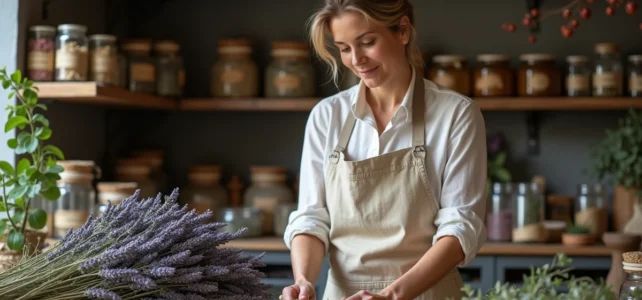
You have probably noticed that herbal teas and herbal shops are blooming in city centers, well beyond the usual organic stores. Herbalism in France is undergoing a rapid transformation, driven by new training programs, a clearer regulatory framework, and events that bring together producers, curious individuals, and health professionals around local medicinal plants.
Herbalism Training: Now Certified Courses Eligible for CPF
For a long time, learning herbalism involved private workshops, books, and oral transmission. Since 2024, things have changed. Courses registered with the RS or RNCP allow for obtaining a recognized title, such as “Consultant in Phytotherapy and Aromatherapy” (RS5432), with durations ranging from four to eight months.
These training programs are eligible for CPF, making them accessible to employees in career transition or wellness professionals looking to enhance their skills. Pharmacies are also sending their staff for training to better advise on local plants.
This structuring marks a turning point. It gives stakeholders in the sector a legitimacy that the industry has been calling for since the abolition of the herbalist certificate in 1941. It also helps to better frame the advice given to the public, distinguishing between general botanical knowledge and health-related matters. Several recent events, which can be followed by checking the news on L’Herbe sous le Pied, testify to this ongoing professionalization across France.
Medicinal Plants in France: What the Law Really Allows Non-Pharmacists to Sell
Have you ever wondered why a herbalist at the market sells loose plants but never ready-to-infuse blends? The answer lies in a regulatory divide that many consumers are unaware of.
List A of the French Pharmacopoeia
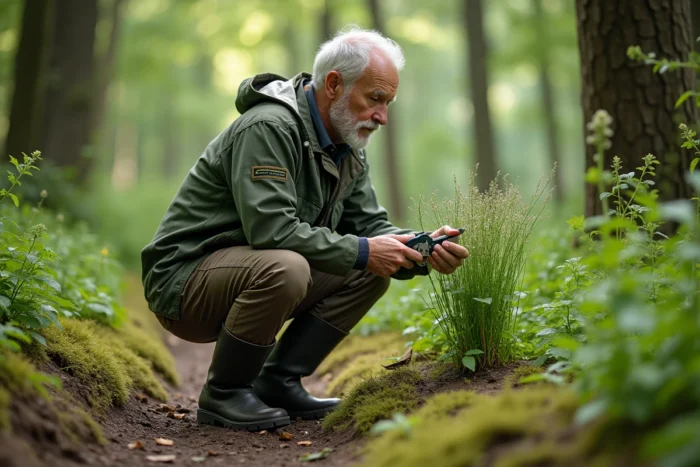
The French Pharmacopoeia lists 148 medicinal plants in its List A. Pharmacists can sell all medicinal plants, prepare custom blends, and advise on dosages. Commercial herbalists (shops, markets, organic stores) can sell the plants from this List A, but only in their natural state, without mixing or preparation.
In practical terms, a producer of medicinal plants in the Drôme Provençale can sell their dried lavender, thyme, or lemon balm in a bag. They cannot offer a herbal tea made up of three plants for insomnia.
The Gray Area of Artisan Preparations
This distinction, inherited from the HPST law of 2008, creates tension. Many farmer-herbalists create balms, syrups, or hydrosols from locally grown plants. The preparation of custom herbal teas remains reserved for pharmacists, which limits the activities of these producers.
The debate regularly resurfaces at professional events. Herbalist associations advocate for an expansion of mixing rights, while the pharmacists’ order defends the monopoly in the name of health safety.
Herbalism Events 2025-2026: What Brings Together the Local Plant Sector
Two types of meetings structure the calendar for herbalism stakeholders in France.
Professional Meetings
The event “The Herb of Tomorrow,” scheduled for November 1, 2025, in Nyons, illustrates the dynamism of the sector. Its Saturday program, open to the general public, combines a market of farmer-herbalists, practical workshops, botanical outings, and conferences. It features:
- A local producers’ market offering herbal teas, oils, balms, and hydrosols made from plants grown in sustainable agriculture
- Stands from schools and training organizations in herbalism, allowing direct exchanges with trainers
- Live micro-distillations, demonstrating how to extract an oil or hydrosol
- Guided botanical outings scheduled at several times throughout the day
This format, blending knowledge transmission and direct sales, is found in many regions of France.
Public Exhibitions
Culturally, the exhibition “Secrets of Herbalists, the (Super) Powers of Local Plants” will be held at Mont Saint-Michel from January 10 to June 28, 2026. Its multisensory and interactive approach distinguishes it from traditional botanical exhibitions. It offers recipes and remedies based on plants, accompanied by a program spread over several months (walks in the salt marshes, discovery of the plant resources of the bay).
These initiatives show that herbalism is moving out of the circle of insiders to reach a broader, family-oriented audience curious to understand what grows around them.
Development of Local Plants in Agriculture: A Sector Challenge
The cultivation of local medicinal plants in France is experiencing a resurgence of interest driven by several converging factors. Short supply chains are developing, consumers want to know where their chamomile comes from, and farmers are looking for high-value crops on small surfaces.
The sector remains fragmented. Unlike large-scale crops, there is no central aggregator or standardized pricing for French medicinal plants. Each producer negotiates their prices and outlets, often through direct sales or small regional cooperatives.
This fragmentation has an advantage: it fosters diversity in cultivated varieties and adaptation to local terroirs. A producer in the Ardèche mountains does not cultivate the same species as a farmer-herbalist in Brittany. Local knowledge, transmitted during sector events, nourishes this diversity.
The development of local production faces a recurring obstacle: the lack of accessible technical references. Cultivation guides for St. John’s wort, yarrow, or lemon verbena are less documented than those for wheat or vines. Professional associations and agricultural chambers are beginning to fill this gap, but the work remains considerable.
French herbalism is currently built on three simultaneous pillars: recognized training that professionalizes advice, a legal framework that is still debated but increasingly understood, and events that weave connections between producers, practitioners, and the general public. The next step will likely be legislative, with the ongoing question of the herbalist’s status.