
When you type “Rikmod” into a search engine to find a free streaming movie, you come across a nebula of links, clones, and redirects. The site regularly changes its domain name, sometimes overnight. This instability is not a bug; it is a direct symptom of a model that operates outside the framework of French law, with concrete consequences for those who use it.
Automated Blocking of Pirate Streaming Sites in France
Since the adoption of the law on the governance of professional sports, France has a mechanism for automated and real-time blocking of pirated streams. Initially designed for illegal sports broadcasts, this system also covers movie and series streaming sites.
In practical terms, Arcom can request internet service providers to cut access to a domain name without going through a lengthy judicial process. For a site like Rikmod, this means that a functional domain in the morning can be inaccessible by evening.
This is the main reason for the repeated name changes. Rikmod became Ovoob, then other variants. Each block leads to a migration to a new domain, with every time the risk for the user of landing on a fraudulent clone rather than the “real” site. To learn everything about Rikmod and its alternatives, one must first understand this regulatory context that makes these platforms structurally unstable.
Concrete Risks for Rikmod Users
It is often thought that only administrators of pirate platforms risk prosecution. French court decisions from March 2026 show that end users of illegal streaming services are beginning to be sanctioned with fines of a few hundred euros.
At the same time, the Council of State confirmed in July 2026 the end of the graduated response system inherited from Hadopi, deemed contrary to the fundamental rights guaranteed by EU law. Arcom is limited to sending warning emails for peer-to-peer, but compensates by intensifying the blocking of sites and streams.
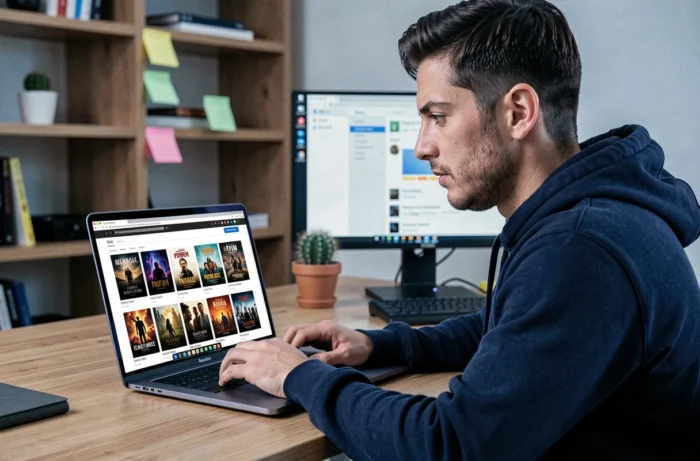
The risk does not stop at the legal level. From a technical standpoint, unofficial free streaming sites pose three recurring problems:
- Aggressive ad redirects that open windows sometimes containing malicious scripts capable of installing unwanted software on your device.
- The absence of reliable encryption for connections, exposing your browsing data (IP address, viewing habits) to third parties.
- Clones and fake mirrors that imitate the interface of the original site to collect personal or banking information under the pretext of a “free registration.”
Using a VPN masks your IP address but does not protect against clicking on a malicious link or against a fake registration form.
Free and Legal Streaming: The AVOD Platforms That Work
The AVOD (advertising-funded video) model has emerged as a credible alternative to paid subscriptions. Several platforms offer legal, free access without technical risks.
France.TV and ARTE.TV
France.TV provides access to all programs from the France Télévisions group. The catalog exceeds 40,000 programs, with replays available for up to 30 days and exclusive content. Registration is free. ARTE.TV complements the offering with documentaries, auteur cinema, and European series, often in original version with subtitles.
Other Options to Consider
Several services are worth testing based on your preferences:
- YouTube offers a wide catalog of full movies available for free, funded by advertising, with reliable video quality.
- Rakuten TV has a free section with recent movies in AVOD, accessible without a subscription.
- Plex TV aggregates licensed free content, with an interface reminiscent of Netflix, without mandatory registration for the free part.
- Molotov TV allows you to watch live television and replays, with a basic offer at no cost.
None of these platforms expose you to legal risks or malware. The trade-off is advertising, usually a few breaks of 30 seconds to a minute.
Rikmod vs. Legal Platforms: What Weighs in the Balance
The main argument for Rikmod remains access to recent movies, sometimes still in theaters, without paying. On paper, it’s tempting. In practice, video quality varies greatly (poor resolution copies, out-of-sync audio tracks, approximate automatic subtitles).
Legal AVOD platforms offer stable image quality, professional subtitles, and uninterrupted viewing without intrusive advertising. The catalog is more limited for recent releases, which is the main difference. Very recent films only appear after their theatrical and paid VOD release window.
Feedback varies on this point, but for the majority of everyday uses (watching a movie in the evening, catching up on a series), legal free platforms largely cover the need. The benefit-risk ratio clearly leans in their favor when you add up the possible fines, malware, and chronic instability of unofficial sites.
Legal free streaming in France has never been so abundant. Rather than navigating between clones of a site that changes its name every month, testing two or three AVOD services is enough to cover most viewing desires without compromising the security of your devices or risking a fine.