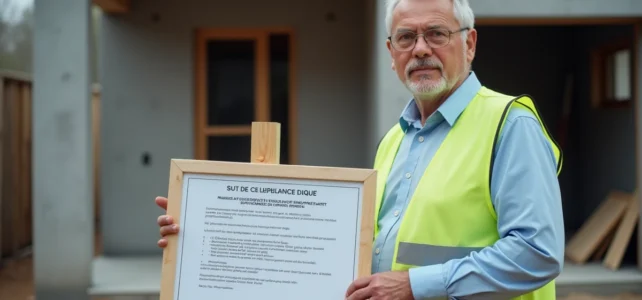
The prior declaration of works panel is a regulatory display document that every applicant must install on their land as soon as they receive the urban planning authorization. This panel, visible from the public road, triggers the third-party appeal period set at two months. Without compliant display, this period does not run, and a neighbor can contest the project long after the start of the construction site.
Notary report and display: a precaution that free templates do not explain
Downloading a panel template and printing it is not enough to protect a construction or renovation project. The central question remains the proof of continuous display throughout the appeal period.
Project managers now recommend, particularly in sensitive areas (coastal regions, protected sectors, dense neighborhoods), to have a notary certify the installation of the panel on the land. This report covers the date of first installation, the compliance of the mentions, and the continuity of the display. It constitutes an enforceable piece of evidence in case of a dispute before the administrative court.
This professional practice changes the way the panel is used: it is no longer just a simple form to fill out, but a link in the legal security of the project. A downloadable template, no matter how complete, is only valuable if it is displayed according to the rules and this reality can be demonstrated.
You will find a free works declaration panel on Actu Immobilier that includes the updated mentions, but keep in mind that the printed document is only the first step.

Mandatory mentions on a prior declaration panel
A prior declaration of works panel does not contain the same information as a building permit panel. Confusing them exposes one to non-compliant display, thus legally ineffective.
The mentions required by the urban planning code for a prior declaration are as follows:
- The name of the beneficiary, the date of issuance, and the number of the prior declaration, as well as the nature of the authorized works
- The area of the concerned land and the address of the town hall where the file can be consulted by third parties
- The mention of third-party appeal rights, with a reminder of the two-month period starting from the first day of continuous display on the land
- If applicable, the mention of the obligation to hire an architect and their name
The decree of May 24, 2018, removed a mention that was previously required, rendering some models still in circulation obsolete. Checking the update date of a PDF template before printing it avoids displaying an incomplete panel.
Regulatory dimensions of the panel
The panel must be rectangular and measure at least 80 centimeters on each side. The characters must remain legible from the public road. A panel that is too small or printed in fine characters on an A4 sheet does not meet this requirement, even if all mentions are present.
For a compliant result, prefer printing on a rigid support (honeycomb panel, expanded PVC) or, if not possible, on sufficiently dense paper that is laminated to withstand the elements throughout the display period.
Display duration and third-party appeal period
The panel must remain in place on the land for the entire duration of the works, and at least for the two-month appeal period. The first day of visible and continuous display marks the starting point of this period.
If the panel falls, degrades, or becomes unreadable, the appeal period may be considered interrupted. Third parties (neighbors, associations) then have a new starting point to contest the urban planning authorization before the town hall or the administrative court.
Disputes related to loss of sunlight
Among the frequent appeals, the contestation for loss of sunlight regularly arises in house extension or construction projects. Neighbors may invoke a prejudice related to the height or placement of the project, relying on the rules of the local urban planning plan.
A rigorous and documented display limits procedural attack angles, as it deprives the applicant of the argument of late or incomplete display. The substance of the appeal remains possible, but the admissibility outside the deadline is excluded.
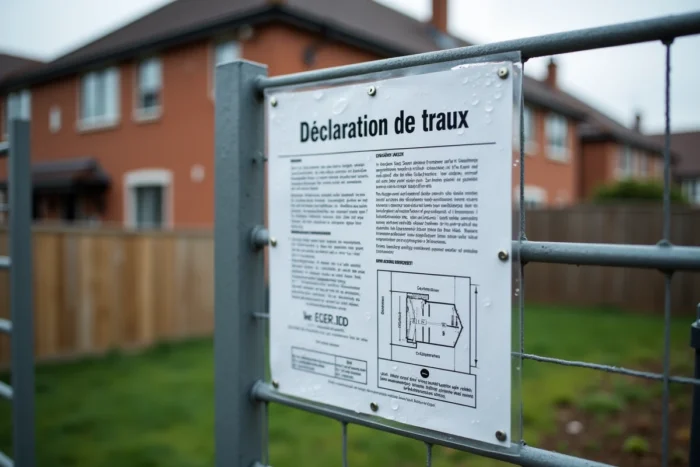
Printing a works declaration panel: PDF format and suitable support
Most free templates available online come in the form of a fillable PDF file. The process is simple: download the file, fill in the fields (name, declaration number, land address, area, nature of the works), and then print.
The choice of printing support determines the durability of the panel. Two common options:
- Printing on thick paper followed by lamination: an economical solution, suitable for short-term works, but vulnerable to prolonged humidity
- Direct printing on PVC or Akilux panel: more resistant to the elements, this support lasts several months outdoors without warping
- Online printing from a specialized site: some printers offer customized construction panels in regulatory dimensions, delivered ready to install
Regardless of the support, ensure that the dimensions meet the minimum regulatory requirements and that all mandatory mentions remain legible from several meters away.
Common mistakes to avoid on the panel
Omitting the prior declaration number or confusing “building permit” and “prior declaration” on the panel renders the display non-compliant. Another pitfall: failing to mention the land area or indicating an incorrect area. Each missing or inaccurate mention weakens the legal validity of the display.
A well-filled prior declaration panel, printed on a durable support, and displayed without interruption on the land remains the best protection against late appeals. The document itself costs little, but the consequences of a faulty display can delay a project by several months.