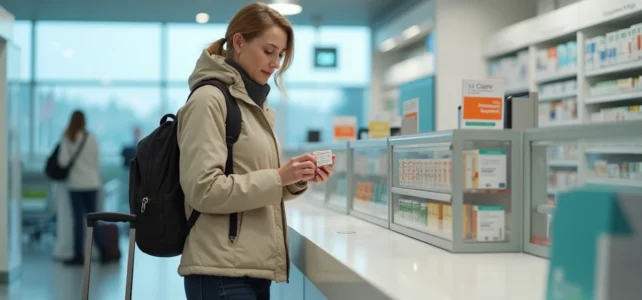
Transporting paracetamol to Norway raises a question that few travelers consider before departure: what quantity is actually allowed, and what documents may be required at the border? Norway applies a stricter regulatory framework than most European countries regarding the importation of medications, including those sold over the counter. Understanding the thresholds and the expected documentation helps avoid confiscation at customs.
Paracetamol in tablets or liquid: two different treatments at security
The pharmaceutical form of paracetamol changes the game at the airport. Tablets and capsules are not subject to the liquid restrictions in carry-on luggage. They pass through security without container constraints.
On the other hand, paracetamol in syrup or liquid form falls into the liquid category. It must therefore comply with the applicable container limit in carry-on luggage and be presented in a resealable transparent bag. This distinction, rarely mentioned in general guides, can lead to concrete issues at airport security.
| Form | Carry-on liquid restrictions | Recommended documents | Risk at security |
|---|---|---|---|
| Tablets / capsules | None | Original packaging, prescription if large quantity | Low |
| Syrup / liquid solution | Yes (liquid rules) | Original packaging, prescription, medical certificate | Moderate |
| Suppositories | None | Original packaging | Low |
| Effervescent sachets (powder) | None | Original packaging | Low |
For those preparing a stay in Scandinavia, a detailed guide on transporting paracetamol in Norway with Voyagoo covers specific cases related to combined treatments.
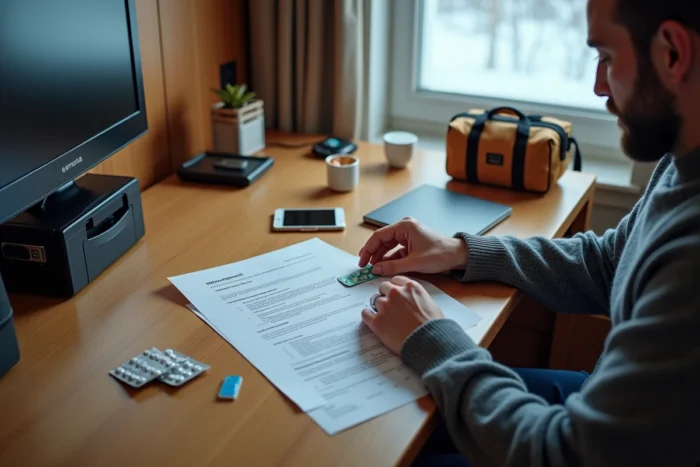
Allowed quantity of paracetamol at Norwegian customs
The Norwegian authorities set the limit for importing medications for personal use at three months of treatment maximum. This rule applies to paracetamol just like any other medication, whether prescribed or over-the-counter.
The calculation is based on the prescribed or usual dosage. For an adult taking paracetamol occasionally, a few boxes are more than enough to cover this duration. Beyond the volume corresponding to three months, a prescription becomes mandatory to justify the quantity.
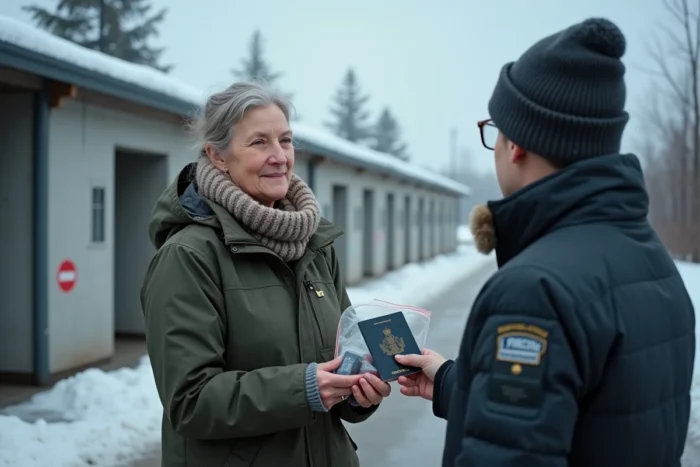
The point of caution lies in proving personal use. Customs officers may request justification at any time, and the absence of usable documentation (prescription, medical certificate, readable pharmacy label) exposes one to immediate confiscation. The original packaging remains the first accepted proof: it displays the name of the medication, dosage, and country of dispensing.
Paracetamol combined with codeine: a special case
Medications combining paracetamol and codeine fall into a different category. Codeine is classified as a controlled substance in most Scandinavian countries. Transporting codeine-containing paracetamol requires a detailed medical certificate, ideally translated into English or Norwegian. Without this document, the risk of refusal at the border significantly increases compared to paracetamol alone.
Documents to prepare before departure for Norway
The difference between a smooth passage and a blockage at customs often lies in the quality of the documents carried. Here are the documents that cover most situations:
- The original medical prescription, mentioning the name of the molecule (INN), dosage, and duration of treatment. A copy is not always sufficient if the customs officer requires the original.
- A medical certificate written in English, stating that the medication is prescribed for personal use. This document is particularly important for chronic treatments or medications containing monitored substances.
- The original packaging of the medication, with the pharmacy label visible. Removing tablets from their box to save space is the most common mistake: without packaging, the medication becomes suspicious.
- A certificate from the National Agency for the Safety of Medicines (or equivalent depending on the country of residence) for treatments containing psychotropic or narcotic substances associated with paracetamol.
Tablets without original packaging are the most frequently confiscated. This observation is common in most feedback from travelers facing Norwegian customs checks.
Buying paracetamol locally: the Norwegian system
Norway regulates the sale of over-the-counter medications more strictly than France or Belgium. Only products approved by the Norwegian Medicines Agency are found on the shelves of pharmacies (apotek) and certain authorized shops.
Paracetamol in tablet form is readily available at pharmacies. Some supermarkets and gas stations also offer it, but in limited packaging. Restrictions may apply depending on the buyer’s age and the quantity requested.
Norwegian pharmacies and brand names
Paracetamol is sold under different brand names in Norway. Asking for “paracetamol” in INN works in all pharmacies, but local brands vary. The Norwegian pharmacist will easily guide you to the available equivalent. However, the prices of OTC medications in Norway are significantly higher than those in France, which justifies bringing your own supply within the allowed limit.
Storing paracetamol during a stay in Norway
The Norwegian climate does not pose major issues for storing tablets. Excessive heat, the main factor in the degradation of paracetamol, is rarely a concern in Scandinavia. The risk is greater during transit, especially during layovers in airports where the temperature in the hold can fluctuate.
Keeping medications in carry-on luggage rather than checked baggage better protects their integrity. The hold can drop to very low temperatures on long-haul flights, which can affect certain pharmaceutical forms, particularly suppositories and syrups.
- Keep tablets in their original blister pack, away from moisture.
- Place liquid forms in a sealed bag in case of pressure changes.
- Check the expiration date before departure: an expired medication may be refused during a check.
The ideal travel kit for Norway contains a reasonable quantity of paracetamol, in its packaging, accompanied by a prescription if the treatment exceeds occasional use. The real filter at Norwegian customs remains the consistency between the quantity transported and the proof of personal use. A clear dossier resolves the issue in seconds at the checkpoint.