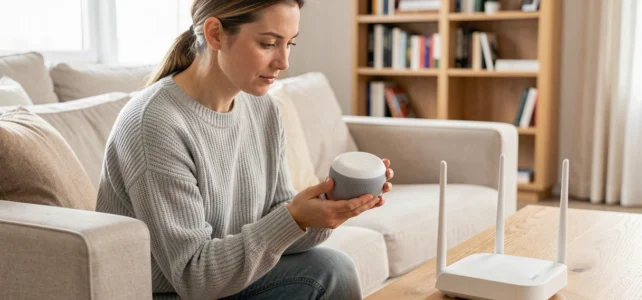
The Freebox Pop runs on Android TV, giving it native access to Google Assistant. Setting up voice control on this player is not just about activating a microphone: the outcome depends on the system version, the associated Google account, and the compatibility of devices connected to the network.
This article details the settings that truly influence how Ok Google works on the Freebox Pop, including a recent change that modifies access to the assistant from a smartphone.
Freebox Pop and Thread protocol: a network role often overlooked
Competing guides present the Freebox Pop as a simple TV player with voice commands. The technical reality goes further. According to a Logis Connect guide published in August 2026, French Internet boxes now integrate Thread routers, which includes the Freebox. This evolution means that the Pop player participates in the network infrastructure for Matter-compatible devices.
Specifically, Thread is a low-power communication protocol that allows smart home accessories (locks, sensors, bulbs) to communicate without a dedicated proprietary bridge. By integrating this protocol, the Freebox Pop reduces the number of gateways needed in a connected home.
When you use Ok Google to control a Matter-compatible device, the voice command passes through Google Assistant, but the communication with the object may potentially go through the Freebox’s Thread router. This dual role, as an Android TV player and a Thread network node, changes the way we think about configuration. It’s not enough to pair a Google account: you also need to ensure that the Freebox is updated to support these protocols.
For those who want to set up my Freebox Pop device with Ok Google considering this network dimension, the procedure begins with a firmware update of the player via the system settings.
Ok Google on Freebox Pop vs on Android smartphone: what’s changing in 2026
One point that most tutorials do not mention yet: access to Google Assistant from an Android smartphone is disappearing. According to an article from Les Numériques published on August 5, 2026, Google Assistant on mobile will soon be discontinued. The command “Ok Google, set up my device” will remain functional directly on the Freebox Pop player (Android TV), but will no longer be available in the same way from a phone to set up the box remotely.
This change has practical consequences on how to approach the initial setup.
| Function | Freebox Pop Player (Android TV) | Android Smartphone (after Assistant shutdown) |
|---|---|---|
| “Ok Google” Command | Available via voice remote | Not available (replaced by Gemini) |
| Initial Device Setup | Via Android TV settings | Via Google Home app only |
| Voice Home Automation Control | Yes, natively | Limited to Gemini functions |
| Pairing Matter/Thread | Possible if firmware is up to date | Via Google Home (not via Assistant) |
In summary, the Freebox Pop player becomes the main entry point for Google voice commands in a Free household. The smartphone will only serve to manage settings via the Google Home app, without the voice layer of the old Assistant.
Android TV settings to check before activating voice command
Before saying “Ok Google” in front of the Freebox Pop remote, several technical conditions must be met. The voice assistant only works correctly if the system is in a specific state.
- The Google account associated with the player must be the same as the one used in the Google Home app on your phone; otherwise, the connected devices will not be synchronized.
- The language of the Android TV system must be set to French (Google Assistant on Android TV is available in French, German, English, Korean, Spanish, Indonesian, Italian, Japanese, and Brazilian Portuguese).
- A system update must be checked in Settings, then About, then System Update: some Matter features are only accessible with the latest firmware versions.
- The Freebox’s Internet connection must be active and stable, as each voice command is processed by Google servers.
If any of these parameters are not met, the voice command may seem to work (the microphone picks up the voice) but will not trigger any action. A poorly synchronized Google account is the most common cause of failure during the initial setup.
Freebox Pop Voice Remote: Activation and Recognition Limits
The Freebox Pop remote includes a dedicated microphone. To send a command, you must hold down the Assistant button, speak, and then release it. This operation differs from Google Home speakers, which listen continuously after the trigger word “Ok Google.”
This distinction is far from trivial. On a connected speaker, you can chain multiple requests without touching anything. On the Freebox Pop, each command requires a physical press of the button. Continuous, hands-free control is only possible if you add a Google Home speaker or a Nest Mini to the network, connected to the same Google account.
The recognized commands on the player cover menu navigation, launching applications (Netflix, YouTube, Molotov), adjusting the volume, and controlling smart home devices paired via Google Home. However, some complex commands (multi-step routines, conditional commands) work more reliably from a dedicated speaker than from the TV player.
Google Home and Freebox Pop Setup: The Link Between App and Player
The Google Home app, available on the Play Store, remains the control center for organizing household devices. It is in this app that you assign the Freebox Pop to a room, group connected objects, and create voice routines.
The Freebox Pop player automatically appears in Google Home once the Google account is synchronized. If not, you need to check that the player and the phone are on the same Wi-Fi network, then restart the detection in the Devices tab of the app.
Google Home manages the configuration, the player executes the voice commands. This division of roles clarifies a common misunderstanding: the app does not replace voice command; it prepares it. Once the devices are correctly declared in Google Home, the voice takes over directly on the player.
With the gradual discontinuation of Google Assistant on smartphones, this architecture becomes even more relevant. The Freebox Pop player, paired with Google Home for management and the remote for voice execution, now constitutes the main foundation for voice control in a Free-equipped household.