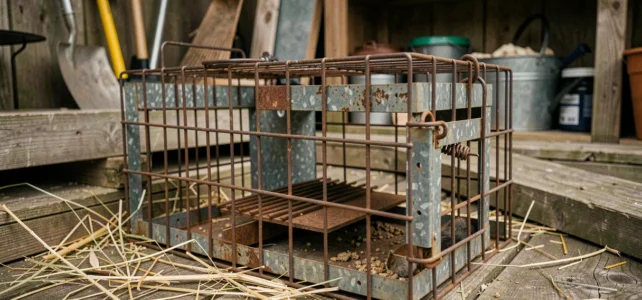
The cage trap for martens sold in DIY stores meets a specific need, but its effectiveness depends as much on the chosen model as on the regulatory framework governing its use. Since the ministerial decree 2026-2029 on ESOD, trapping conditions have changed, including for individuals equipped with a simple trap purchased off the shelf.
ESOD Decree 2026-2029: Distance Constraints and Departmental Variations
The ministerial decree published in 2026 redefines the classification of the marten as a species likely to cause damage. The major new development is the introduction of distance restrictions from buildings: trapping is only allowed within 250 m of a building or farm in most configurations.
This geographical criterion changes the game for anyone considering setting a cage trap at the edge of a property or in an isolated shed. Before installing anything, we recommend consulting the prefectural decree of your department, as the national list coexists with local variations that may remove the marten from the ESOD classification.
This is the case in Deux-Sèvres, where a decree from August 21, 2026, excludes the marten from the ESOD list until 2029. In this department, an individual setting a marten trap is subject to prosecution. The trap may be perfectly legal twenty kilometers away, in a neighboring department, and completely prohibited in your area.
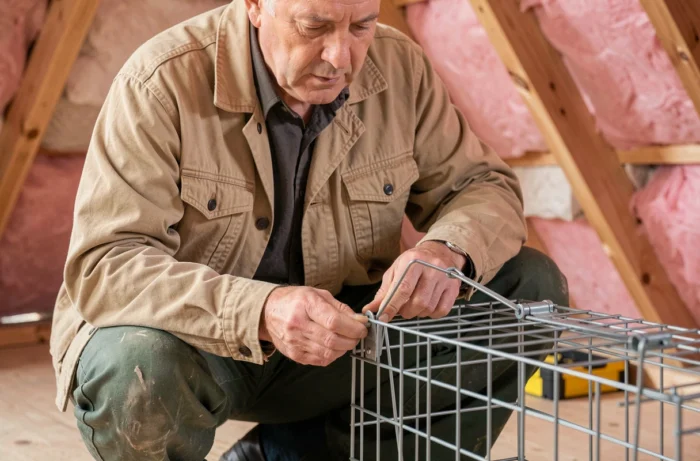
Galvanized Steel Cage Trap: Technical Selection Criteria
The models available in DIY stores may look similar at first glance, but a few technical characteristics separate a functional trap from one that will allow the marten to escape. To guide your choice towards the marten trap from Brico Dépôt suitable for your situation, focus on three points.
- Mesh and wire thickness: the marten bites and pushes with surprising force for its size. A mesh that is too fine (wire less than 2 mm) deforms after a few escape attempts. Opt for sufficiently thick galvanized steel wire to withstand repeated bites.
- Trigger system with a paddle or taut wire: the central paddle remains the most reliable mechanism for non-lethal trapping. The taut wire, which is cheaper, sometimes triggers in vain due to vibrations or wind.
- Single or double entry: the double-entry cage increases the likelihood of capture when the trap is set on an identified path (along a wall, between two obstacles). The single-entry cage is better suited for a confined space like an attic.
Minimum Dimensions for an Adult Marten
An adult marten measures between 40 and 55 cm (body only, excluding the tail). Cages that are too short cause the trap to jam on the animal, injuring it and rendering the trap non-compliant with regulations on non-lethal traps. Aim for an interior length of at least 80 cm and a cross-section of 25 to 30 cm.
Trap Positioning and Bait Selection: Common Mistakes
The marten follows regular routes. Setting a trap randomly in an attic is like hoping it will change its habits. We observe that most capture failures stem from poor placement, not from a bad trap.
First, identify signs of passage: elongated droppings of 8 to 10 cm, scratch marks on beams, food remains (pits, feathers). The trap should be placed directly on this traffic axis, ideally along a wall or in a corner, as the marten tends to follow walls rather than cross open spaces.
Documented Baits and Counterproductive Baits
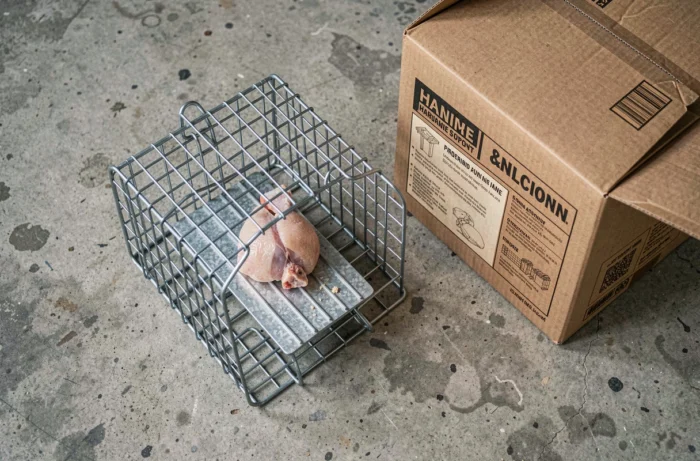
An intact whole egg (with shell) remains the most consistently effective bait. The marten detects the smell and cannot resist an accessible egg. Fresh grapes and pieces of raw poultry also work well. However, very odorous baits (sardines, strong cheese) also attract cats and hedgehogs, leading to false triggers and wasting the trap.
Place the bait at the back of the cage, behind the trigger paddle. If the bait is too close to the entrance, the marten can grab it without activating the mechanism. Secure it with a thin wire or wedge it in the mesh so that it must fully enter the cage.
After Capture: Legal Obligations and Release
A non-lethal trap requires checking the cage at least once a day. Leaving a captured animal without water or shelter for more than twenty-four hours constitutes an act of cruelty punishable by law. This daily check obligation is outlined in the texts governing ESOD trapping.
The release must be done at a sufficient distance to prevent a quick return. In practice, several kilometers are necessary, as the marten has an effective sense of direction and a territory it knows well. Release it in a wooded area, far from any habitation, to minimize the risk of conflict with other residents.
If your department has removed the marten from the ESOD list, only a licensed trapper can legally intervene. The license is obtained after specific training with the departmental hunters’ federation. Purchasing a cage trap does not exempt you from this requirement when it is necessary.
Prevention (blocking access points larger than 5 cm, eliminating food sources, trimming branches touching the roof) remains more sustainable than repeated trapping. A trap solves a one-time problem. Sealing the entries prevents the next one from arriving.