A centralized locking system that no longer responds puts the driver in an immediate dilemma: force the mechanism at the risk of damaging it or wait for an intervention whose cost remains unclear. The system relies on a set of interdependent electronic and mechanical components, and the failure can stem from something as simple as a blown fuse or a software defect in the control module. Before disassembling anything, some methodical checks often help locate the source of the blockage without worsening the situation.
Check manufacturer recall campaigns before any intervention
Classic troubleshooting articles systematically point to replacing the remote control battery or checking the fuses. These reflexes are useful, but they overlook a documented problem for several years: some centralized locking failures are related to software defects identified by the manufacturers themselves.
At Peugeot and other brands in the Stellantis group, failures in the security module have disabled the interior handles while the vehicle’s engine was running. This type of malfunction cannot be resolved by simply changing a door actuator. It requires a software update performed at the dealership, often covered under a recall.
The concrete approach involves entering the vehicle’s VIN on the manufacturer’s website and on the government platform RappelConso. If a recall concerns the locking system, any paid repair undertaken before this verification risks being unnecessary. To delve deeper into the issue of centralized troubleshooting with Serrurier Dic, this preliminary step remains the most reliable starting point.
Diagnosing a failure in a centralized locking system: where to start
The diagnosis becomes more effective when it follows a specific order, from the simplest to the most complex. Skipping steps often leads to replacing parts that are still functional.
Remote control and power supply
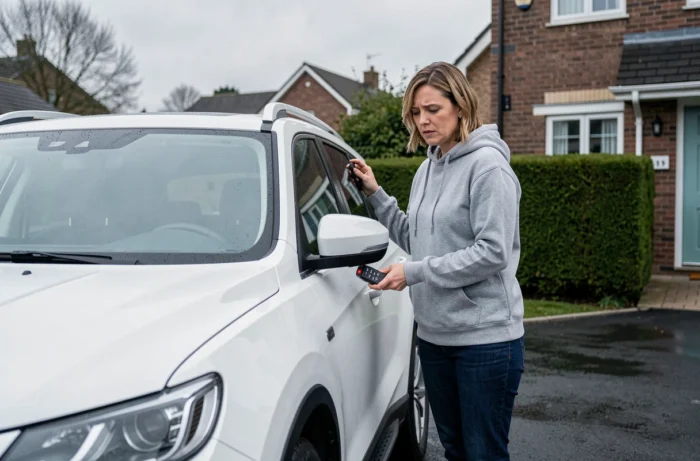
The remote control battery remains the most common cause of the system’s non-response. A quick test: bring the remote control as close to the vehicle as possible and press the button. If the locking works at very close range, the battery is weak but the receiver module is intact.
If the remote control does not provoke any reaction regardless of the distance, the problem lies either in the transmitter (dead battery, damaged internal circuit) or on the vehicle’s receiver side. Testing with the physical key helps clarify: if the driver’s lock opens manually and the centralized locking then activates normally from the inside, the fault is located in the remote control.
Fuses and electrical harness
A blown fuse cuts power to the central control unit. The location of the fuse dedicated to the centralized locking varies by model, but it is generally found in the box under the dashboard or in the engine compartment. The vehicle manual indicates its exact position and amperage.
A fuse that blows repeatedly signals a short circuit in the harness. The cable passages in the doors are particularly vulnerable: repeated bending during opening and closing eventually damages the insulation. A bare wire in the door passage causes intermittent failures that are difficult to reproduce in the workshop.
Faulty door actuator
When a single door refuses to lock while the others function, the actuator (electric motor integrated into the door) is the main suspect. The diagnosis can be confirmed by listening: a sharp click without movement of the latch indicates a stuck mechanism, while complete silence points to a non-functional actuator or a cut cable.
Here are the points to check in order for an effective diagnosis:
- Test the remote control at different distances and check the vehicle’s response with the physical key
- Check the fuse dedicated to the centralized locking and visually inspect its condition
- Listen to the sound of each actuator by activating the locking from the cabin to isolate the faulty door
- Examine the electrical harness in the door boot for pinched or bare wires
Vehicle safety during troubleshooting: points not to neglect
Intervening on a centralized locking system without precautions can create risky situations, especially on newer vehicles where the system also manages the alarm and anti-theft features.
Disconnecting the battery before touching the electrical harness protects both the technician and the onboard electronics. On some models, a sudden disconnection resets the control module, requiring the remote control to be reprogrammed. Consulting the vehicle’s technical documentation before disconnecting avoids this complication.
Fully electronic centralized locks, without a manual latch, pose a specific safety issue. In the event of a complete circuit failure, the doors may remain locked with no possibility of opening from the outside. This scenario has led to massive recalls in the automotive industry, particularly in China, where millions of vehicles have been affected by electronic handle defects.
During any intervention on the locking mechanism, keeping a window slightly open is a simple precaution against the risk of accidental locking inside the vehicle.
Replacement of parts and limits of amateur troubleshooting
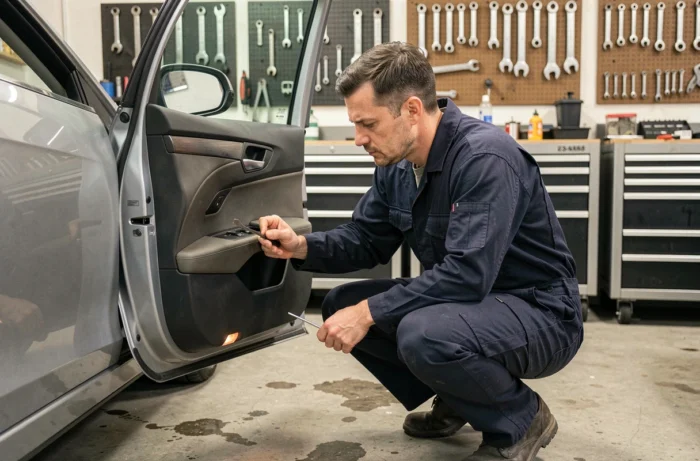
Changing a remote control battery or a fuse requires neither specific tools nor particular skills. Replacing a door actuator, however, involves removing the interior door panel, disconnecting the harness, and handling the locking mechanism. The difficulty varies greatly from one model to another.
Field reports differ on the reliability of generic actuators sold online. Some function identically to original parts, while others have dimensional or torque discrepancies that reduce their lifespan. Checking exact compatibility with the manufacturer’s reference limits this risk.
Three situations justify entrusting the repair to a professional:
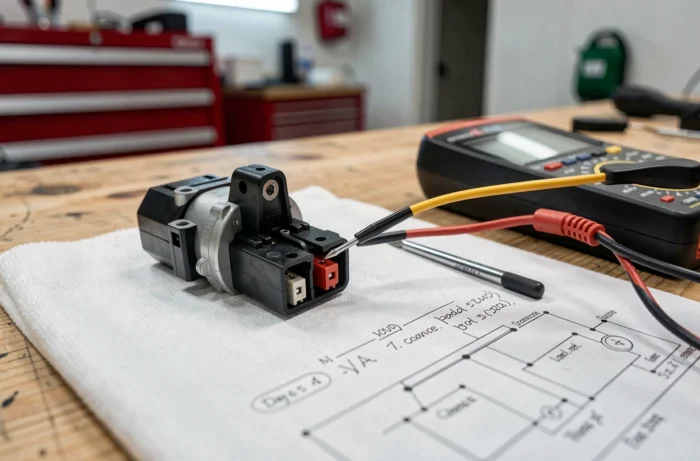
- The fuse blows repeatedly, indicating a short circuit requiring diagnosis with a multimeter
- The central control unit no longer responds after checking the power supply and fuses
- The vehicle is equipped with a keyless system whose reprogramming requires a manufacturer diagnostic tool
Troubleshooting a centralized locking system always begins with the simplest checks: manufacturer recalls, battery, fuse. Failures that resist this initial screening generally relate to the electrical harness or the control module, two components whose repair requires appropriate tools and reading of fault codes. Keeping this logic in mind avoids replacing parts at random and turning a quick intervention into an expensive project.