
Turning the steering wheel while the car is completely stationary remains a common reflex, both during parking maneuvers and parallel parking. This habit, often inherited from driving lessons, puts stress on several mechanical components well beyond just the tire. Steering, transmission, geometry: the consequences of repeated steering while stationary accumulate over the months and eventually weigh on the vehicle’s maintenance budget.
Steering crossmember and structural fatigue: the part we forget
Automotive content regularly discusses tire wear or the power steering pump. One component almost systematically goes unnoticed: the steering crossmember. This crossbar connects the two wheel hubs and transmits the steering movement. When the wheels pivot without rolling, the friction between the tire and the pavement creates a resistance that the crossmember absorbs directly.
According to a technical guide published by Piecesetpneus, the structural fatigue of the crossmember significantly worsens with stationary steering, especially on heavy or frequently loaded vehicles. A family SUV packed with luggage or a delivery van on a full route multiplies the stresses on this part with each maneuver performed with the wheels locked on the ground.
Signs of a fatigued crossmember (play in the steering, knocking noise during slow turns, asymmetric tire wear) appear gradually. Replacement, on the other hand, requires a visit to the workshop and a complete realignment of the geometry, which significantly increases the bill beyond the cost of the part alone.
Understanding the importance of turning the wheels while stationary allows one to realize how this seemingly trivial action engages ground connection components that are rarely monitored during regular maintenance.

Alignment and tire wear: a vicious circle accelerated by stationary steering
The link between stationary steering and tire wear is known. What is less understood is the intermediate mechanism: repeated steering throws off the alignment, which in turn accelerates the degradation of the tires. Alignment (or toe-in) refers to the angle formed between the wheels when viewed from above. A deviation of just a few tenths of a degree is enough to cause sawtooth wear on the tread.
With each stationary turn, the lateral forces exerted on the steering links and ball joints can imperceptibly alter this angle. Taken in isolation, a single parallel parking maneuver changes nothing. Repeated several times a day for months, these micro-shifts eventually push the geometry out of the manufacturer’s tolerances.
Warning signals to watch for
- A slightly off-center steering wheel when driving straight, even after correctly inflating the tires
- More pronounced wear on the inner or outer edge of a single front tire
- A vehicle pulling to one side on flat, dry roads, without crosswinds
- A dull rubbing noise during slow turns, distinct from the usual screeching
Having the alignment checked at least once a year (or after hitting a curb) limits damage. However, reducing stationary steering remains the simplest prevention to space out these checks.
Electric power steering and ADAS sensors: modern components more exposed than one might think
In recent vehicles, hydraulic steering has been replaced by electric power steering (EPS). An electric motor, controlled by a computer, provides assistance for steering. Turning the steering wheel while stationary requires maximum assistance effort, as there is no rolling help to reduce friction with the ground.
The electric steering motor then operates at full load for several seconds, a working regime for which it is not designed to run continuously. Field reports documented by specialized technicians indicate premature failures of the EPS module on urban vehicles subjected to frequent maneuvers in underground parking.
The problem does not stop at the motorization. ADAS systems (lane-keeping assistance, semi-autonomous parking) rely on a steering angle sensor located in the steering column. This sensor continuously recalibrates its zero position. Sudden and repeated stresses while stationary can generate calibration drift, causing false alerts or erratic behavior of the parking assistance.
Most affected vehicles
Electric city cars, often heavier than their thermal counterparts due to the battery, combine two aggravating factors: a high weight on the front axle and almost exclusively urban use with frequent maneuvers. For these models, protecting the steering system requires the habit of rolling, even slowly, before turning.
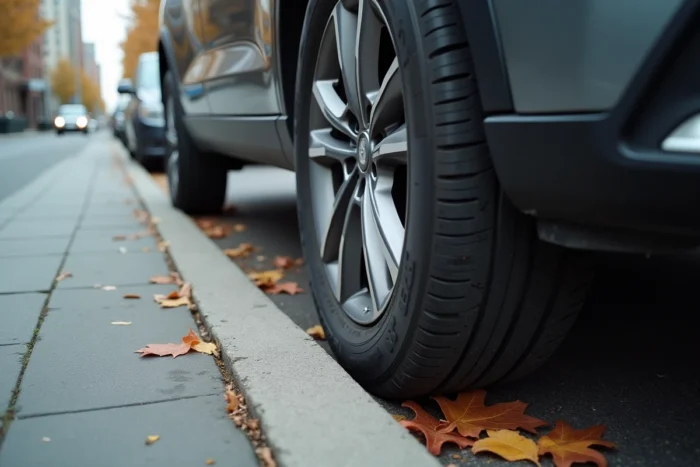
Adopting the right gesture: steer while moving rather than stationary
The solution requires no equipment or expense. Simply steer while the vehicle is moving forward or backward, even at very low speed. This movement, no matter how slow, significantly reduces friction between the tire and the road, and thus the stresses transmitted to the entire steering system.
- Before turning, release the brake and let the vehicle roll at one or two kilometers per hour
- When parallel parking, alternate between moving forward and backward rather than turning the wheels fully while stationary
- When parking on a slope, orient the wheels towards the sidewalk once the vehicle is stabilized by the handbrake, not before
This reflex reduces tire wear, preserves the crossmember and steering links, spares the electric power steering motor, and keeps the front axle geometry within its tolerances for a longer time. Field reports vary on the exact lifespan gain of the parts, as it depends on the vehicle’s weight, the road surface, and the frequency of maneuvers. However, the cumulative effect over several years of urban use remains significant.
Drivers who maneuver daily in the city (delivery drivers, ride-hailing drivers, parents making quick drop-offs) have every interest in adopting this gesture. A simple roll of a few centimeters before turning is enough to halve the mechanical stresses on the steering and front axle. It is probably one of the least expensive and most effective preventive maintenance actions a driver can adopt.