
The protein content of milk varies from one to three times depending on its animal or plant origin, and on the formulation of the product. A glass of cow’s milk provides around 8 g of protein, while some plant-based drinks fall below 2 g. To increase daily protein intake through milk, the choice relies less on a general category and more on the actual composition of each product.
Casein and whey: what makes cow’s milk proteins so complete
Cow’s milk contains two families of proteins: casein (about four-fifths of the total) and whey (the rest). Casein is digested slowly, prolonging the feeling of fullness. Whey, on the other hand, is absorbed quickly by the body and promotes muscle synthesis after exercise.
This duo of proteins provides all the essential amino acids, those that the human body cannot produce on its own. Leucine, present in significant amounts in whey, plays a direct role in the reconstruction of muscle fibers. For athletes or older individuals looking to maintain their muscle mass, this complete contribution makes cow’s milk a nutritional benchmark that is hard to match.
A detailed article on proteins in milk on Gourmand Sans Gluten explains these differences in composition between animal and plant milks.
Skimmed milk retains almost all of its proteins despite the removal of fat. Choosing semi-skimmed or skimmed milk does not penalize protein intake while reducing the caloric density of the glass.
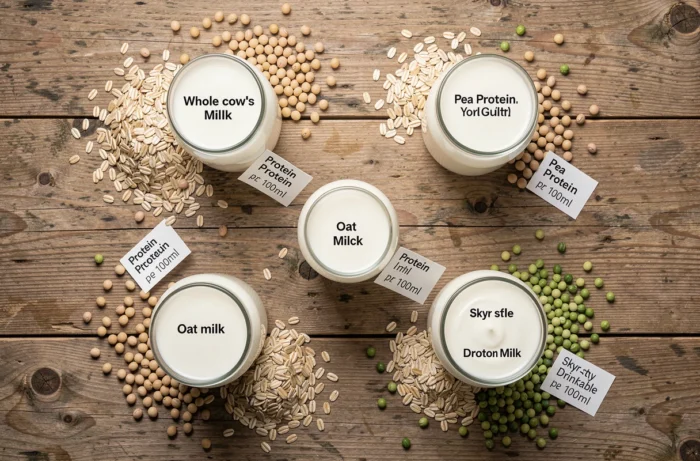
Protein content of plant milks: soy and pea ahead of the rest
Not all plant-based drinks are equal in protein, and the gap between them is considerable. A study published in 2024 in the Journal of the Academy of Nutrition and Dietetics, covering 219 plant-based drinks, showed that soy and pea are the only alternatives close to the protein profile of cow’s milk.
Soy milk has a protein content comparable to that of cow’s milk, with a relatively complete amino acid profile. Pea milk also approaches this benchmark, thanks to the natural richness in protein from the legume it originates from.
Low-protein drinks
Almond milk, oat milk, and rice milk contain significantly less protein per glass. These drinks have other qualities (texture, taste, digestibility), but they do not constitute a relevant choice for increasing protein intake.
The same study highlights that composition varies greatly from brand to brand, even within the same category. A protein-enriched oat milk may have a very different profile from a regular oat milk. Reading the nutritional label remains the only reliable way to compare.
- Soy milk: protein content close to cow’s milk, almost complete amino acid profile
- Pea milk: good protein density, often enriched with calcium and vitamins
- Almond, oat, or rice milk: low protein content, to be supplemented with other sources
- Enriched drinks: always check the amount of added protein, which varies by manufacturer
Protein-enriched milk and filtration: a growing segment
The market now offers cow’s milk that has undergone ultrafiltration. This mechanical process concentrates the proteins in the milk while removing some lactose and water. The result is a milk that can contain up to twice as much protein as regular milk, without adding external protein powder.
These ultrafiltered milks target a specific audience: athletes in recovery, older individuals with sarcopenia, or anyone looking to increase their protein intake without multiplying portions. Their taste remains close to traditional milk, with a slightly thicker texture.
Enriched milk versus protein powder
Adding a whey (whey protein) concentrate to a glass of regular milk is another common strategy. The difference with ultrafiltered milk lies in practicality: ultrafiltered milk can be consumed as is, without preparation or dosing. For daily use integrated into meals (cereals, coffee, cooking), it offers higher protein intake without altering eating habits.

Reading the label: concrete benchmarks for comparing milks
The determining criterion is found on the nutritional table, at the line “Proteins per 100 ml”. Comparing this value between several products allows for an objective choice, independent of marketing or claims on the packaging.
- Check the protein content per 100 ml (and not per serving, which varies in volume by brand)
- Control the ingredient list: a plant milk enriched with pea protein will be more interesting than a simple plant milk
- Look at the amino acid score: the presence of the nine essential amino acids guarantees a complete protein
Claims such as “high in protein” are regulated by European legislation. For a product to display this label, proteins must represent at least 20% of the total energy value. This threshold serves as a useful filter in the aisle.
Between regular cow’s milk, ultrafiltered milk, and soy milk, the final choice depends on individual dietary constraints (lactose intolerance, vegan diet, athletic goals). From a strictly protein standpoint, cow’s milk and soy milk remain the two densest and most complete options in amino acids.