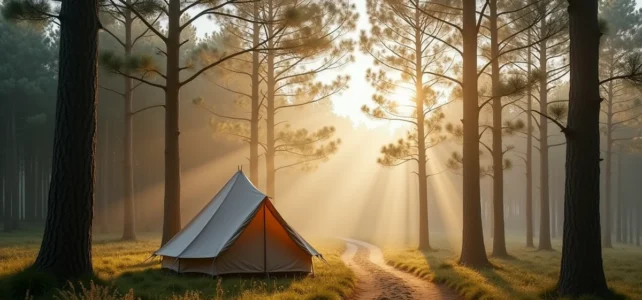
The choice of a tent pitch in the Landes is not just about comparing stars or prices. The soil, the orientation of the plot, the proximity to a water table, and the vegetation cover determine the actual quality of the stay, well before considering additional amenities.
Sandy soil, drainage, and anchoring: what the Landes terrain requires for your tent
Almost the entire department rests on a sandy substrate, which radically changes the constraints of setup. Classic steel pegs do not hold well in fine, dry sand. We recommend using winged pegs or long V-shaped models, driven in at an angle, to ensure stable anchoring even in strong west winds.
This sandy soil, however, offers rapid natural drainage after a shower. Pitches located under maritime pines benefit from a carpet of needles that absorbs moisture and limits mud. Conversely, plots on the edge of wet areas or near waterways (Contis stream, Huchet stream) may experience water rise through capillarity during prolonged rain.
Before pitching, we advise checking if the terrain has a slight natural slope. A difference of a few centimeters is enough to drain runoff water away from the tent. Campsites located on former forest plots often retain this micro-relief, while areas completely leveled by bulldozers create artificial depressions.
To find a tent camping pitch in the Landes that takes these parameters into account, one must look beyond the descriptive sheet and directly ask the manager about the nature of the soil of the assigned plot.

Forest cover and microclimate: choosing between dense pine forest and coastal clearing
The shade of a maritime pine reduces the temperature inside the tent by several degrees compared to an exposed plot. In July and August, this difference transforms the experience. Pitches under dense pine forests (closed canopy) offer appreciated coolness but limit ventilation. The resin that falls on the flysheet is a concrete inconvenience that few descriptions mention.
Coastal clearings, particularly between Mimizan and Vieux-Boucau, offer an interesting compromise. The sea breeze ensures constant ventilation, and the sunshine allows for quick drying of a damp tent in the morning. In return, gusts can be strong at the end of the day. A tent with good wind resistance (aluminum poles, complete guying) then becomes essential.
Natural areas versus large wooded campsites
Natural camping areas, limited by regulations to a small number of pitches, maintain a minimally altered vegetation cover. The density of occupancy remains low, which preserves the calm and local biodiversity (red squirrels, woodpeckers, cicadas).
Large 4 or 5-star campsites have wider and better-defined plots, often with electric hookups and water points nearby. The technical comfort is superior, but the noise proximity increases proportionally with the occupancy rate. In high season, we observe that pitches at the back of the park, away from sanitary blocks and activity areas, remain the most sought after by nature campers.
Seasonality and attendance: why May, June, and September change everything
Industry professionals report a growing demand for tent stays outside of the high season. May, June, and September offer favorable weather conditions in the Landes, with pleasant temperatures for sleeping under canvas and significantly reduced attendance.
Outside of high season, the ratio of space available per camper increases significantly. Pitches close to the ocean, usually crowded in July, become accessible without long-term reservations. The Landes forest, less frequented, regains its calm: walks on the trails of the Regional Natural Park of Landes de Gascogne can be done without encountering crowds.
- In May and June, evenings remain cool: plan for a comfortable sleeping bag and an insulating groundsheet to compensate for the cold rise from the sand.
- In September, late summer storms are common on the Landes coast. A tent with sealed seams and a closed awning effectively protects the equipment.
- Ocean swimming remains possible from June to the end of September, but not all surveillance posts are active outside of July-August: check with local municipalities for the opening dates of monitored areas.
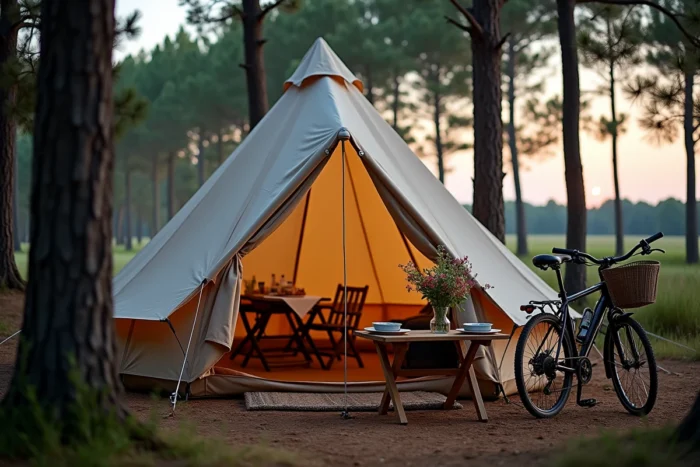
Declaration obligations and nature labels: what to check before booking
The growth of micro-structures (small campsites, natural areas, unusual accommodations) in the Landes has led to increased controls by municipalities and tourist offices. Any outdoor accommodation must be subject to a declaration at the town hall and comply with public reception rules. An undeclared site exposes the camper to administrative closure during the stay.
On the label side, the “authentic nature” offer is increasingly structured around certified approaches. We recommend checking for the presence of an environmental label before booking, rather than relying solely on the marketing rhetoric of the website. Labels attest to concrete practices: wastewater management, limitation of night lighting, preservation of existing vegetation.
- Check that the campsite or natural area has a declaration number visible on its official documents.
- Prefer structures that display a recognized environmental label rather than a simple self-assigned “eco-responsible” mention.
- For pitches by the ocean, consult the coastal safety recommendations issued by municipalities, particularly regarding the risks of rip currents and authorized swimming areas.
Tent camping in the Landes remains one of the few modes of accommodation where the choice of terrain takes precedence over everything else. A well-oriented pitch, under suitable forest cover, on draining soil, with a declared and labeled structure, forms the basis of a nature stay that lives up to its promises. The terrain makes the stay, not the brochure.