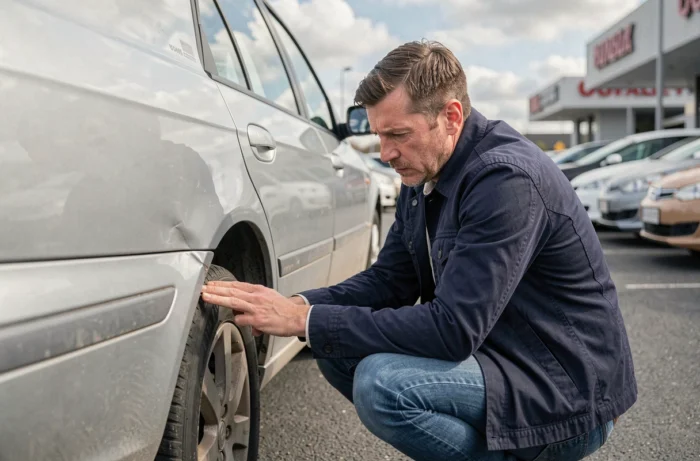
In the French second-hand market, vehicles over 16 years old are gaining ground while younger used cars aged 2 to 5 years are declining. Prices, warranties, and the level of risk vary significantly depending on the age of the vehicle and the purchasing channel. Measuring these differences before signing allows buyers to avoid unpleasant surprises regarding the actual budget for a used car.
Age of the Used Vehicle and Actual Cost: What the Segments Reveal
Recent market data shows a clear shift. Very recent used cars (less than a year old) have seen a volume decrease of about 9.6% compared to the previous year, and young used cars aged 2 to 5 years have declined by about 8.4% in volume.
Conversely, the segment of vehicles over 16 years old is progressing. This shift reflects a budgetary trade-off: faced with high prices for recent models, an increasing share of buyers is turning to older vehicles, which are cheaper to purchase but potentially more expensive in maintenance and repairs.
| Age Segment | Volume Trend | Purchase Price | Mechanical Risk |
|---|---|---|---|
| Less than 1 year | Decrease (approximately -9.6%) | High, close to new | Low, active manufacturer warranty |
| 2 to 5 years | Decrease (approximately -8.4%) | Intermediate | Moderate, wear parts to monitor |
| 6 to 15 years | Stable | Accessible | Variable depending on maintenance history |
| More than 16 years | Increase | Low | High, frequent repairs |
A low-priced vehicle with mileage significantly above the average for its category can incur repair costs that exceed the price difference with a newer model. The total budget includes purchase, maintenance, and wear parts, not just the displayed price.
At Autos Minne, the vehicles offered undergo a technical inspection and a mechanical examination before being put up for sale, which reduces the risk of a blind purchase in this type of market.

Buying from Private Individuals or Professionals: Compared Guarantees and Recourse
The share of distribution groups in the second-hand market has decreased from 21.7% in 2024 to 21.3% in 2025. Buying from private individuals is gaining ground, but legal protections differ radically from one channel to another.
Professional: Legal Warranty and Labeling Obligations
A professional in the automotive industry must label each vehicle for sale with mandatory information: make, model, month and year of first registration, mileage, price. The legal warranty of conformity applies, which grants the right to repair or replacement if a defect appears after purchase.
A technical inspection less than six months old is mandatory for any vehicle over four years old sold by a professional. This document provides information on the condition of the brakes, steering, emissions, and the vehicle’s structure.
Private Seller: Checks at Your Expense
Between private individuals, the legal warranty of conformity does not apply. Only the warranty against hidden defects can be invoked, with the burden of proof resting on the buyer. In practice, it must be proven that the defect existed before the sale and that the seller was aware of it.
- Request a technical inspection less than six months old, mandatory for vehicles over four years old even when sold between private individuals.
- Ask for the complete maintenance history: invoices for servicing, replacement of wear parts (brake pads, timing belt, shock absorbers).
- Check the consistency between the displayed mileage and the overall condition of the vehicle (wear on the steering wheel, pedals, condition of the seats).
- Consult the certificate of non-pledge to ensure that the vehicle is neither pledged nor under opposition.
The absence of a maintenance history is a major warning sign, regardless of the asking price. A private seller who keeps no invoices makes it impossible to reliably estimate the mechanical condition.
Mileage, Maintenance History, and Mechanical Inspection: The Three Decisive Filters
The price and exterior appearance are not enough to evaluate a used vehicle. Three criteria help distinguish a good deal from a financial pitfall.
Mileage remains the primary indicator of wear. However, low mileage on an older vehicle may indicate long periods of inactivity, which can lead to degradation of seals, hoses, and batteries. A regularly driven vehicle often ages better than a stationary vehicle.
The maintenance history documents the interventions performed. A timing belt replaced within the manufacturer’s prescribed intervals, regular oil changes, and follow-ups at a dealership or recognized garage are markers of reliability. Conversely, a blank service book or missing invoices over several years complicates any estimation of the budget for refurbishment.
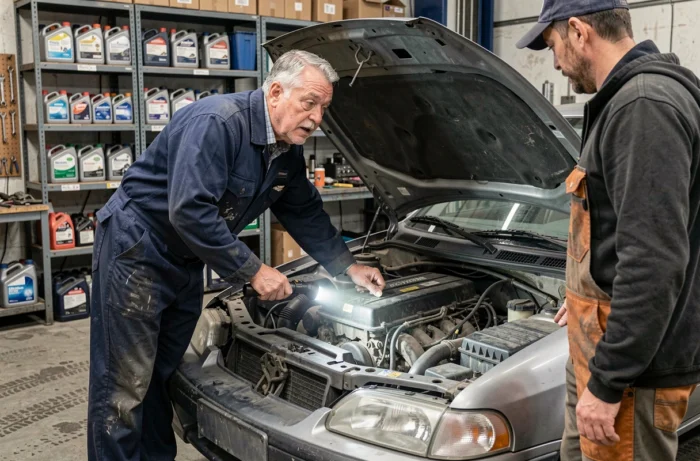
The mechanical inspection before purchase, conducted by an independent mechanic, covers points that the technical inspection does not always detect: condition of the clutch, play in the steering, engine compression, condition of the gearbox. The cost of this inspection represents a fraction of the price of an unforeseen repair.
- Start the engine cold to detect abnormal noises (knocking, hissing).
- Test the gearbox on the road, including uphill and downshifting.
- Check the color of the exhaust smoke: blue smoke indicates abnormal oil consumption, persistent white smoke signals a head gasket problem.
Used Electric Vehicle: A Unique Segment in the Automotive Market
Prices for used electric vehicles show a downward trend. This decline is explained by the arrival on the secondary market of models from the first waves of sales, combined with the rapid evolution of battery range in new models.
For a buyer, the condition of the battery determines the actual value of the electric vehicle. A battery diagnostic (State of Health) measures the residual capacity compared to the original capacity. A vehicle whose battery has lost more than a quarter of its capacity will see its actual range decrease proportionally.
The conversion bonus has not been available since December 2024 for all vehicle categories. This factor alters the budget calculation for those who were counting on this assistance to finance a switch to electric through the second-hand market.
The second-hand market is increasingly segmented between low-priced older vehicles and recent used cars at higher prices. Regardless of the targeted segment, examining the maintenance history and having an independent mechanical inspection remain the two most effective levers to secure a purchase. The purchase price alone reveals little about what the vehicle will actually cost over the next two or three years.