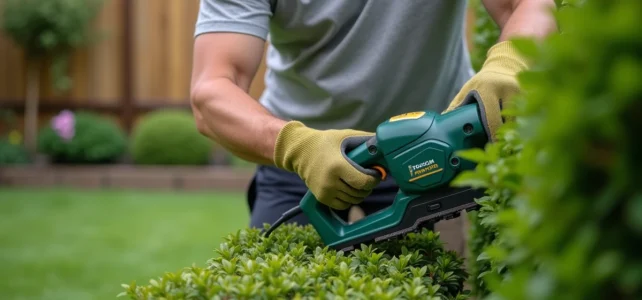
Between two models displaying similar characteristics on paper, the choice of an electric hedge trimmer rarely comes down to raw power. The actual frequency of trimming, the noise level tolerated by neighbors, and the nesting period of birds weigh just as heavily in the balance as a difference of a few hundred watts. This article compares the criteria that concretely differentiate electric hedge trimmers, starting from data often absent from traditional guides.
Overall cost of an electric hedge trimmer: battery vs. corded over five years
Choice guides compare the purchase price, but the actual cost of a battery hedge trimmer far exceeds the initial investment. According to data cited by Que Choisir and Futura Sciences, a hedge trimmer battery typically lasts three to five years, or five hundred to a thousand charge cycles.
Replacing a lithium-ion battery often represents an amount close to the price of a new entry-level device. In a corded model, this expense disappears: the lifespan depends on the motor and blades, not on a component with planned obsolescence.
| Criterion | Corded | Battery |
|---|---|---|
| Purchase price | The lowest in the category | Higher (battery included) |
| Battery replacement cost | Not applicable | Close to the price of a new corded model |
| Battery longevity | Not applicable | 3 to 5 years (500-1,000 cycles) |
| Routine maintenance | Minimal | Minimal + battery management |
| Noise level | Low | Low |
| Mobility | Limited by the cord | Total |
For gardens where an electrical outlet is within reasonable reach, a good comparison of corded and cordless models is available at taille-haie-electrique.com, which details performance differences based on usage.
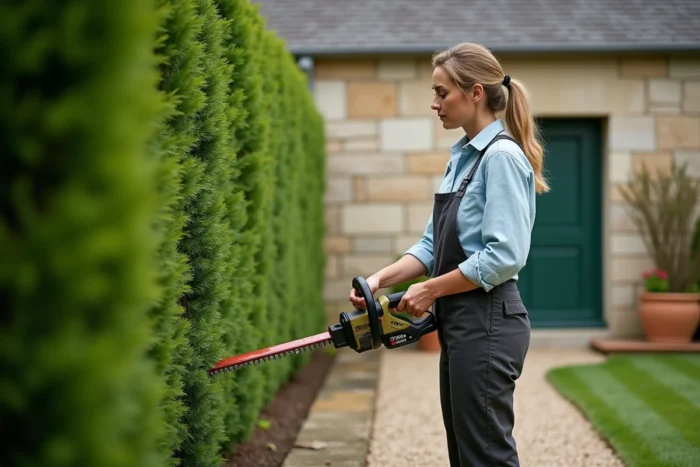
Trimming frequency and neighborhood constraints: two underestimated criteria
Most hedges require two to three trims per season. This frequency influences the choice more than one might think.
Adapting the motorization to its actual rhythm
A garden with a low hedge trimmed twice a year does not justify a powerful model or an investment in a high-end battery system. On the other hand, a dense hedge trimmed three times a season puts more strain on the blades and motor: the frequency of trimming conditions wear much more than power.
An entry-level corded model is sufficient for occasional maintenance. For regular use on substantial hedge lengths, a battery model offers mobility that reduces accumulated fatigue over the season.
Noise and allowed trimming hours
Electric hedge trimmers (both corded and battery) produce a noise level significantly lower than thermal models. This is a concrete advantage in residential areas where municipal regulations govern the hours of use for motorized gardening equipment.
- On weekdays, trimming is generally allowed in the morning and afternoon, with a break at lunchtime.
- On Saturdays, the time slots are often reduced, and Sundays are limited to a few hours in the middle of the day.
- A quieter device allows for starting earlier without generating friction with neighbors, thus extending the effective working window.
A silent electric hedge trimmer offers more flexible timing than a thermal model, even in the strictest municipalities.
Electric hedge trimmer and protection of nesting birds
This criterion is absent from almost all choice guides, even though it is regulated. In France, trimming hedges is prohibited from March 15 to July 31 to protect the nesting of birds, according to provisions related to good agricultural and environmental conditions (BCAE). This rule applies to agricultural operations, but the logic of protection extends to all gardens.
Trimming outside this period implies concentrating maintenance on two windows: late winter (February to early March) and late summer (August to September). This constrained schedule has a direct consequence on the choice of equipment.
Why this schedule changes the choice of tool
In February, low temperatures reduce the capacity of lithium-ion batteries. A corded model does not suffer from this loss of performance. Conversely, at the end of summer, the vegetation is dense and the stems are stiffer: a spacing of the teeth suitable for semi-woody branches becomes a priority.
Rather than choosing a hedge trimmer solely based on blade length, it is better to check the spacing of the teeth and the maximum cutting capacity advertised by the manufacturer. A long blade with a narrow spacing will get stuck on thick late-season shoots.
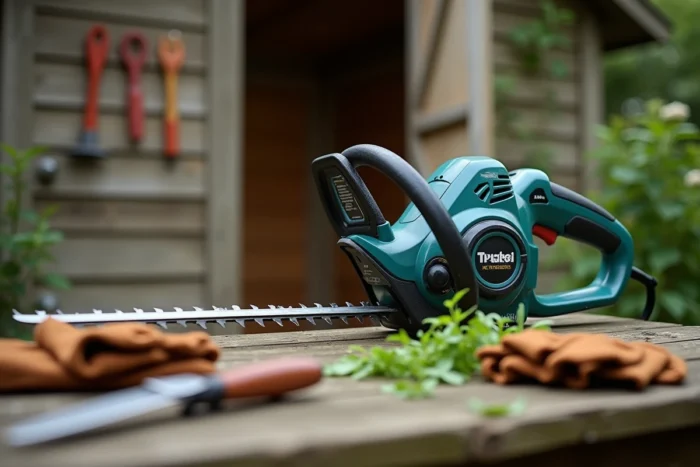
Weight, ergonomics, and fatigue: what the technical sheet doesn’t say
Search engine results compare power in watts and blade length, but the weight/ergonomics ratio determines the actual quality of work, especially for prolonged sessions.
A lightweight hedge trimmer that is poorly balanced tires more than a slightly heavier model with a rotating handle and a well-placed center of gravity. The comfort of grip is as important as the gross weight displayed on the label.
- The rotating rear handle allows switching from horizontal to vertical cutting without straining the wrist.
- A transparent hand guard offers better visibility of the cutting area.
- The presence of an anti-vibration system reduces fatigue on the forearms during repeated trimming.
Testing the grip in-store, with arms extended at shoulder height for about thirty seconds, provides a more reliable indication than any technical sheet.
The choice of an electric hedge trimmer benefits from integrating the actual trimming calendar, local noise constraints, and wildlife protection. A model suited to these parameters will remain efficient and relevant over several seasons, whereas a purchase based solely on power risks disappointing at the first practical constraint.