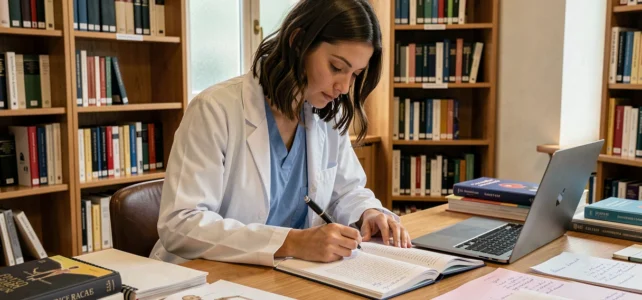
Becoming a physiotherapist in France requires a five-year study program after the baccalaureate. This total is divided into a university year serving as an access filter, followed by four years in a specialized training institute. The state diploma obtained at the end of this course grants the master’s degree.
Health Access Year: the University Filter Before the IFMK
The first year does not take place in a physiotherapy school. It occurs at the university, within a scientific-focused program whose main function is to select candidates admitted to the institute.
Three options currently coexist for this first year:
- The PASS (specific health access pathway), which combines a health major with a minor in another discipline such as law, psychology, or computer science.
- The L.AS (health access license), which operates in mirror: the major focuses on a non-medical discipline, complemented by a health minor. It is possible to apply to IFMK at the end of the first year or after the second.
- A classic license of the STAPS type or biology, which allows in certain universities to apply to a partner IFMK.
The choice between these pathways depends on the student’s academic profile and the agreements signed between each university and the IFMKs in its region. Not all pathways provide access to the same institutes or the same number of places.
For those wondering how many years of study to become a physiotherapist, the answer has remained stable since the 2015 reform: five years in total, regardless of the access route chosen in the first year.
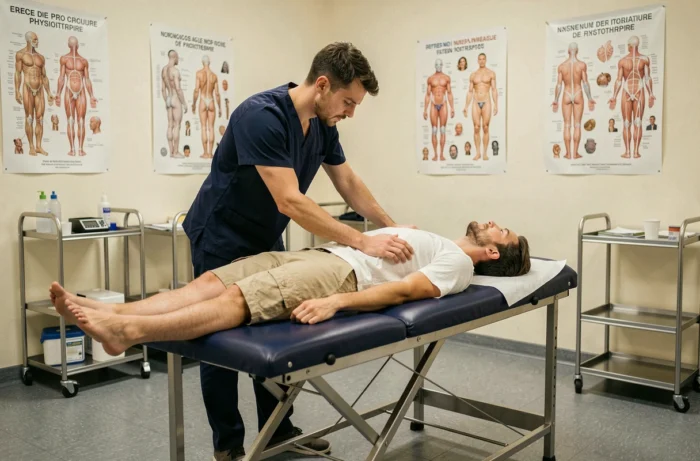
2027 Reform: Elimination of PASS and L.AS for Physiotherapy
The landscape of this first year is set to change. The government officially announced on April 17, 2026, the end of the PASS and L.AS pathways starting from the 2027 academic year. A single access route to health studies will replace them, harmonized across the entire territory.
This reform affects all MMOPK fields (medicine, midwifery, dentistry, pharmacy, physiotherapy). For a high school student entering L1 in 2027, the first year will no longer formally be called PASS or L.AS.
The overall structure of five years remains unchanged: one access year followed by four years in IFMK. What is evolving is the regulatory framework and the organization of selection, not the duration of the course.
This information has a concrete impact on high school students currently in their final year. Preparing their Parcoursup file in 2026 for entry in 2027 involves directly consulting target universities, as the precise modalities of the single pathway have not yet all been published.
Training in IFMK: Four Years Towards the State Diploma
Once admitted, the student joins a training institute in masso-physiotherapy for four years, or eight semesters representing 240 ECTS credits.
First Cycle: Clinical and Scientific Foundations
The first two years in IFMK cover anatomy, biomechanics, physiology, and basic rehabilitation techniques. Clinical internships begin at this stage, with a gradual exposure to patients.
The goal of this first cycle is to build clinical reasoning. The student learns to conduct a physiotherapy diagnostic assessment, meaning to evaluate a patient’s motor abilities before defining a care protocol.
Second Cycle: Specialization and Thesis
The last two years deepen the fields of practice: traumatology, neurology, respiratory rehabilitation, pediatrics, geriatrics. The volume of internships increases significantly, and the student works on a final thesis whose defense is a condition for obtaining the diploma.
The state diploma of masseur-physiotherapist is awarded after validating three elements: the teaching units (including internships), the thesis, and attendance in practical and directed work.
Cost and Disparities in Physiotherapy Studies in France
One aspect rarely detailed in guidance guides concerns the gap in tuition fees between public and private IFMKs. According to Les Échos, some students pay around 178 euros per year while others spend up to 8,000 euros. This disparity depends on the status of the institute and the region.
Public IFMKs or those affiliated with a university charge fees close to standard university tuition. Accredited private institutes, on the other hand, freely set their fees. Over four years of training in IFMK, the cumulative difference can represent several tens of thousands of euros.
Scholarships and financial aid exist, notably the CROUS scholarships for students in public IFMKs. Students in private institutes do not always have access to these, which reinforces inequality.
Periodic Certification: Training Does Not Stop at the Diploma
Since the implementation of the mandatory periodic certification, graduated physiotherapists must validate a continuing education program over a six-year cycle. This system applies to all health professionals, including physiotherapists.
In practical terms, this means that the five years of initial studies represent only the foundation. Throughout their career, the practitioner must update their skills in areas defined by regulations. Failure to comply with this obligation can affect the right to practice.
This point deserves to be integrated into the reflection on the actual duration of training. A physiotherapist practicing for twenty years will have accumulated, in addition to their initial five years, several hundred hours of additional training spread over several six-year cycles.
The pathway to becoming a physiotherapist in France remains set at five years after the baccalaureate, whether the first year goes through a PASS, an L.AS, a STAPS license, or, starting in 2027, the new single pathway. The state diploma then opens up a professional practice regulated by a continuing education obligation that accompanies the practitioner throughout their career.