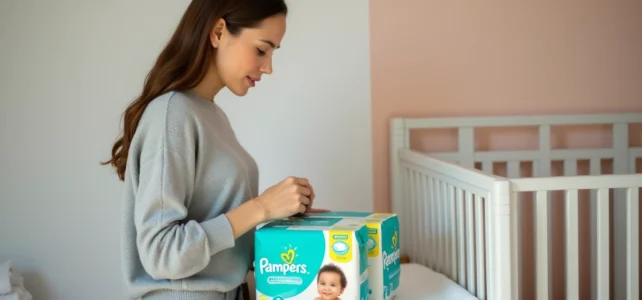
Pampers Harmonie and Pampers Premium Protection both occupy the high-end segment of the Pampers catalog, but they cater to distinct design logics. Comparing these two diapers amounts to measuring two different priorities: skin tolerance on one side, anti-leak performance on the other. This guide places the data side by side to clarify what truly separates them.
Composition and Design: What Distinguishes Harmonie from Premium Protection
| Criterion | Pampers Harmonie | Pampers Premium Protection |
|---|---|---|
| Top Sheet | Partially made from plant-based materials | DermaComfort sheet |
| Lotion / Fragrance | No lotion or fragrance | May contain a protective lotion |
| Chlorine Bleaching | No | Not specified as a main argument |
| Waistband | Soft standard | Flex & Protect waistband |
| Declared Priority | Skin tolerance, reduction of controversial substances | Management of soft stools and moisture, including for premature babies |
Reading this table highlights a clear divide. Harmonie focuses on the composition and transparency of its materials, while Premium Protection prioritizes leak-proofing from the maternity ward. These are not two versions of the same product: they are two responses to two distinct parental questions.
To delve deeper into the differences between Pampers Harmonie and Premium Protection, one must also consider the other Pampers ranges (Baby-Dry, Baby-Dry Night Pants), which target even more specific uses.
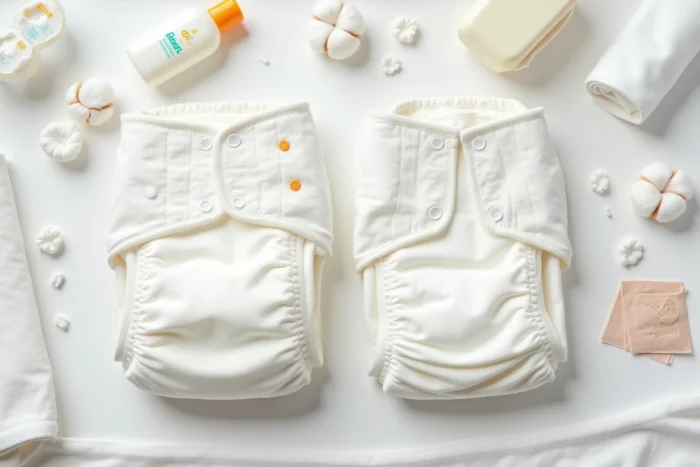
Absorption and Leaks: Pampers Premium Protection vs. Harmonie
The Flex & Protect waistband of Premium Protection is designed to adapt to the movements of the newborn while maintaining a snug fit around the thighs. The DermaComfort sheet channels moisture quickly, reducing prolonged contact between the skin and liquid stools, which are common in the first weeks.
Harmonie does not display the same level of technicality in this area. Its design prioritizes the choice of materials in contact with the skin. Absorption remains adequate for daily use, but parents who experience recurrent nighttime leaks with Harmonie often turn to Premium Protection or the Baby-Dry range, designed to last longer at night.
However, if the baby does not have specific leak issues, the difference in daily absorption between the two ranges remains moderate. The choice then hinges on other criteria.
Sensitive Skin and Skin Tolerance: Harmonie’s Domain
Harmonie has been positioned by Pampers France as the range for ultra-sensitive skin. The absence of fragrance, lotion, and chlorine bleaching constitutes its central argument. The top sheet incorporates plant-based materials, responding to a growing demand from parents concerned about the composition of products in direct contact with the skin.
Premium Protection, on the other hand, also enjoys a solid reputation for skin comfort. Consumer reviews frequently mention great softness and few allergic reactions. The nuance lies in the approach:
- Harmonie minimizes added substances, operating on the principle that fewer ingredients mean less risk of irritation
- Premium Protection incorporates a technical sheet (DermaComfort) that actively pulls moisture away from the skin, limiting diaper rashes through rapid drying
- Both ranges are suitable for sensitive skin, but Harmonie targets parents who want to control composition, while Premium Protection targets those who want to control moisture
Pampers Diaper Prices: Are Harmonie and Premium Protection on the Same Level?
Both ranges are positioned in the high price tier of the Pampers catalog. The price per pack varies depending on the format (single pack, monthly pack) and the distribution channel. Neither is an economical option comparable to Baby-Dry in the long term.
This similar pricing reinforces the idea that the choice between Harmonie and Premium Protection is not made based on budget, but rather on the baby’s profile and the parents’ priorities. A newborn in the maternity ward with frequent stools benefits more from Premium Protection. A baby a few months old, whose transit stabilizes, may switch to Harmonie if the parents prefer a cleaner composition.

What Baby Profile for Which Pampers Diaper
Rather than designating a “winner,” the data points to complementary use:
- Birth and first weeks (soft stools, very frequent changes): Premium Protection with its DermaComfort sheet and Flex & Protect waistband offers the best moisture management
- After the first months, reactive skin or history of irritation: Harmonie without lotion or fragrance limits exposure to added substances
- Persistent nighttime leaks regardless of age: neither is specifically designed for night use, the Baby-Dry range remains more suitable for this purpose
Transitioning from one range to another based on the baby’s development is not unusual. Testing on a small pack before purchasing a monthly format remains the most reliable method, as each child’s morphology influences the fit as much as the design of the diaper itself.
The decisive criterion ultimately boils down to a simple question: is the main issue moisture or composition? The answer directly points to Premium Protection in the first case, to Harmonie in the second.